• Director of National Intelligence Tulsi Gabbard will resign from her role in the coming weeks, her office confirmed to Nextgov/FCW on Friday.

    Gabbard’s husband, Abraham Williams, was “diagnosed with a rare form of bone cancer, and she is stepping away from public service to be by his side and fully support him through this battle,” Olivia Coleman, a spokesperson for the Office of the Director of National Intelligence, said in an email.

    In a Truth Social post that included Gabbard’s resignation note, President Donald Trump said she would be leaving June 30. It marks the fourth major cabinet departure of his second term.

    During Gabbard’s roughly 16-month tenure overseeing the nation’s 18 intelligence agencies, the former Democratic congresswoman and 2020 presidential candidate sought to reshape ODNI around Trump’s priorities while facing persistent scrutiny over her past comments on Russia, Syria, Edward Snowden and surveillance authorities. She was narrowly confirmed to the position in February 2025.

    In office, Gabbard launched a sweeping restructuring effort aimed at shrinking ODNI, including plans to cut staffing and consolidate or eliminate several offices tied to cyber, foreign influence and intelligence integration functions. Supporters framed the moves as long-overdue reforms, while critics warned they could weaken coordination across the intelligence community.

    Gabbard also became a central figure in Trump’s efforts to target former intelligence officials viewed as political adversaries. Last year, she revoked security clearances for dozens of current and former national security officials, accusing some of politicizing intelligence and leaking classified information, which drew sharp criticism from Democrats and former intelligence leaders.

    Her tenure was additionally marked by renewed disputes over U.S. intelligence assessments, including intelligence findings involving Venezuela.

    Gabbard’s political rise was built in part around opposition to U.S. interventionism and what she called “regime change wars,” a posture that at times appeared increasingly at odds with White House actions involving military operations in Iran and Venezuela.

    In March, a Senate hearing highlighted growing tensions between intelligence community assessments of the war in Iran and the administration’s framing of the conflict. It also came a day after the departure of then-aide and National Counterterrorism Center Director Joe Kent, who said he could not agree with the Trump administration’s premise for the war, which was launched alongside Israel in February.

    In the hearing, Gabbard told senators that it’s “not the intelligence community’s responsibility to determine what is and is not an imminent threat” and that the president has authority to make such conclusions.

    In a Friday statement, Sen. Mark Warner, D-Va. the vice chairman of the Senate Intelligence Committee, said his thoughts were with Gabbard and her family. 

    “Anyone who has watched a loved one go through a serious illness understands the toll it takes, and I wish him strength and hope for a full recovery in the difficult days ahead. I also appreciate her willingness to serve her country in a variety of different roles,” he said.

    “The Director of National Intelligence is entrusted with one of the most serious responsibilities in government: providing objective, fact-based intelligence to policymakers and the American people, regardless of politics or pressure from the White House,” added Warner, who often sparred with Gabbard over issues involving her office. 

    “At a time when the boundaries between verified intelligence and politically convenient claims have too often been blurred, it is critical that the office remain grounded in facts, independence, and the rule of law,” he said.

    “I thank Tulsi Gabbard for her service in this administration and in uniform, and I wish her the very best as she supports her husband Abe in his battle with cancer. Please join me in sending them prayers for a full and fast recovery,” said Sen. Tom Cotton, R-Ark., the intelligence committee chairman.

    ]]>

    ¶¶¶¶¶

    ¶¶¶¶¶

    ¶¶¶¶¶

    ¶¶¶¶¶

    ¶¶¶¶¶

  • Authorities in Europe and North America have announced the dismantling of a criminal virtual private network (VPN) service used by criminal actors to obscure the origins of ransomware attacks, data theft, scanning, and denial-of-service attacks. The disruption of First VPN Service was led by France and the Netherlands, with several other nations supporting the investigation since December

    ¶¶¶¶¶

    ¶¶¶¶¶

    ¶¶¶¶¶

    ¶¶¶¶¶

    ¶¶¶¶¶

  • Lawmakers in both houses of Congress are demanding answers from the U.S. Cybersecurity & Infrastructure Security Agency (CISA) after KrebsOnSecurity reported this week that a CISA contractor intentionally published AWS GovCloud keys and a vast trove of other agency secrets on a public GitHub account. The inquiry comes as CISA is still struggling to contain the breach and invalidate the leaked credentials.

    On May 18, KrebsOnSecurity reported that a CISA contractor with administrative access to the agency’s code development platform had created a public GitHub profile called “Private-CISA” that included plaintext credentials to dozens of internal CISA systems. Experts who reviewed the exposed secrets said the commit logs for the code repository showed the CISA contractor disabled GitHub’s built-in protection against publishing sensitive credentials in public repos.

    CISA acknowledged the leak but has not responded to questions about the duration of the data exposure. However, experts who reviewed the now-defunct Private-CISA archive said it was originally created in November 2025, and that it exhibits a pattern consistent with an individual operator using the repository as a working scratchpad or synchronization mechanism rather than a curated project repository.

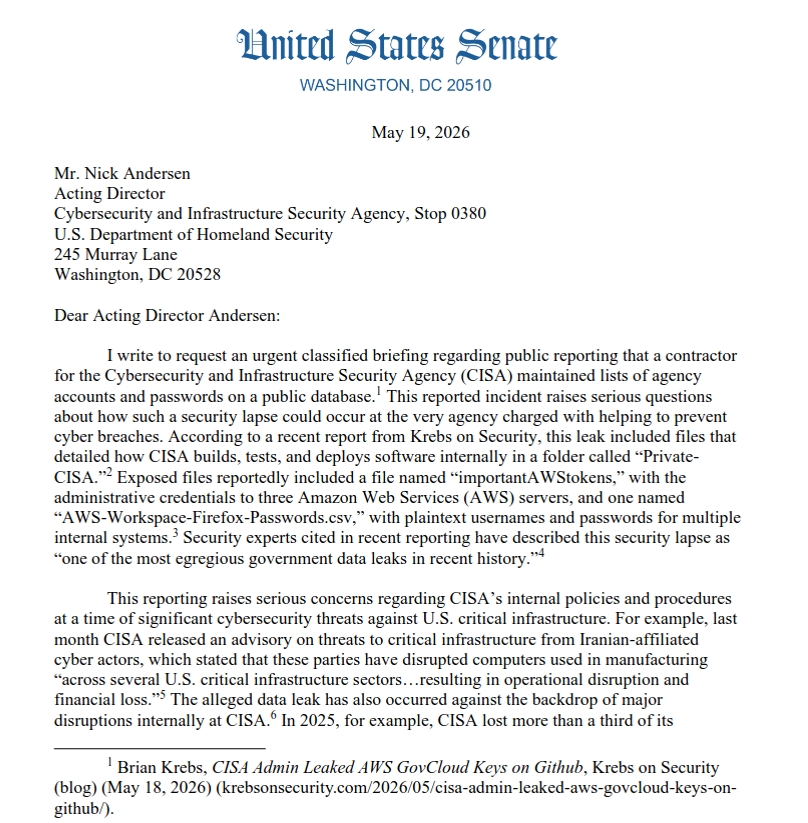
    In a written statement, CISA said “there is no indication that any sensitive data was compromised as a result of the incident.” But in a May 19 a letter (PDF) to CISA’s Acting Director Nick Andersen, Sen. Maggie Hassan (D-NH) said the credential leak raises serious questions about how such a security lapse could occur at the very agency charged with helping to prevent cyber breaches.

    “This reporting raises serious concerns regarding CISA’s internal policies and procedures at a time of significant cybersecurity threats against U.S. critical infrastructure,” Sen. Hassan wrote.

    A May 19 letter from Sen. Margaret Hassan (D-NH) to the acting director of CISA demanded answers to a dozen questions about the breach.

    Sen. Hassan noted that the incident occurred against the backdrop of major disruptions internally at CISA, which lost more than a third of it workforce and almost all of its senior leaders after the Trump administration forced a series of early retirements, buyouts, and resignations across the agency’s various divisions.

    Rep. Bennie Thompson (D-MS), the ranking member on the House Homeland Security Committee, echoed the senator’s concerns.

    “We are concerned that this incident reflects a diminished security culture and/or an inability for CISA to adequately manage its contract support,” Thompson wrote in a May 19 letter to the acting CISA chief that was co-signed by Rep. Delia Ramirez (D-Ill), the ranking member of the panel’s Subcommittee on Cybersecurity and Infrastructure Protection. “It’s no secret that our adversaries — like China, Russia, and Iran — seek to gain access to and persistence on federal networks. The files contained in the ‘Private-CISA’ repository provided the information, access, and roadmap to do just that.”

    KrebsOnSecurity has learned that more a week after CISA was first notified of the data leak by the security firm GitGuardian, the agency is still working to invalidate and replace many of the exposed keys and secrets.

    On May 20, KrebsOnSecurity heard from Dylan Ayrey, the creator of TruffleHog, an open-source tool for discovering private keys and other secrets buried in code hosted at GitHub and other public platforms. Ayrey said CISA still hadn’t invalidated an RSA private key exposed in the Private-CISA repo that granted access to a GitHub app which is owned by the CISA enterprise account and installed on the CISA-IT GitHub organization with full access to all code repositories.

    “An attacker with this key can read source code from every repository in the CISA-IT organization, including private repos, register rogue self-hosted runners to hijack CI/CD pipelines and access repository secrets, and modify repository admin settings including branch protection rules, webhooks, and deploy keys,” Ayrey told KrebsOnSecurity. CI/CD stands for Continuous Integration and Continuous Delivery, and it refers to a set of practices used to automate the building, testing and deployment of software.

    KrebsOnSecurity notified CISA about Ayrey’s findings on May 20. CISA acknowledged receipt of that report, but has not responded to follow-up inquiries. Ayrey said CISA appears to have invalidated the exposed RSA private key sometime after that notification. But he noted that CISA still hasn’t rotated leaked credentials tied to other critical security technologies that are deployed across the agency’s technology portfolio (KrebsOnSecurity is not naming those technologies publicly for the time being).

    Ayrey said his company Truffle Security monitors GitHub and a number of other code platforms for exposed keys, and attempts to alert affected accounts to the sensitive data exposure(s). They can do easily on GitHub because the platform publishes a live feed which includes a record of all commits and changes to public code repositories. But he said cybercriminal actors also monitor these public feeds, and are often quick to pounce on API or SSH keys that get inadvertently published in code commits.

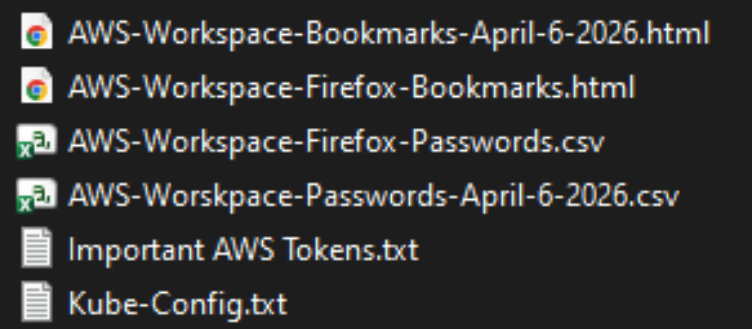
    The Private CISA GitHub repo exposed dozens of plaintext credentials to important CISA GovCloud resources. The filenames include AWS-Workspace-Bookmarks-April-6-2026.html, AWS-Workspace-Firefox-Passwords.csv, Important AWS Tokens.txt, kube-config.txt, etc.

    The Private-CISA GitHub repo exposed dozens of plaintext credentials to important CISA GovCloud resources.

    In practical terms, it is likely that cybercrime groups or foreign adversaries also noticed the publication of these CISA secrets, the most egregious of which appears to have happened in late April 2025, Ayrey said.

    “We monitor that firehose of data for keys, and we have tools to try to figure out whose they are,” he said. “We have evidence attackers monitor that firehose as well. Anyone monitoring GitHub events could be sitting on this information.”

    James Wilson, the enterprise technology editor for the Risky Business security podcast, said organizations using GitHub to manage code projects can set top-down policies that prevent employees from disabling GitHub’s protections against publishing secret keys and credentials. But Wilson’s co-host Adam Boileau said it’s not clear that any technology could stop employees from opening their own personal GitHub account and using it to store sensitive and proprietary information.

    “Ultimately, this is a thing you can’t solve with a technical control,” Boileau said on this week’s podcast. “This is a human problem where you’ve hired a contractor to do this work and they have decided of their own volition to use GitHub to synchronize content from a work machine to a home machine. I don’t know what technical controls you could put in place given that this is being done presumably outside of anything CISA managed or even had visibility on.”

    ¶¶¶¶¶

    ¶¶¶¶¶

    ¶¶¶¶¶

    ¶¶¶¶¶

    ¶¶¶¶¶

  • The Belarus-aligned threat actor known as Ghostwriter (aka UAC-0057 and UNC1151Ukraine’s National Security and Defense Council) has been observed using lures related to Prometheus, a Ukrainian online learning platform, to target government organizations in the country. The activity, per the Computer Emergency Response Team of Ukraine (CERT-UA), involves sending phishing emails to government

    ¶¶¶¶¶

    ¶¶¶¶¶

    ¶¶¶¶¶

    ¶¶¶¶¶

    ¶¶¶¶¶

  • SafeDep uncovered the Megalodon attack targeting 5,561 GitHub repositories with malicious CI workflows and cloud credential theft.

    ¶¶¶¶¶

    ¶¶¶¶¶

    ¶¶¶¶¶

    ¶¶¶¶¶

    ¶¶¶¶¶

  • Hackers are increasingly abusing Middle East telecommunications networks and hosting providers to operate large-scale command-and-control (C2) infrastructure. The findings highlight a strategic shift away from disposable indicators toward infrastructure-level tracking, allowing defenders to identify persistent patterns behind cyber operations rather than reacting to constantly changing indicators of compromise. The dataset reveals that C2 infrastructure dominates […]

    The post Hackers Exploit Middle East Telecoms for Massive C2 Operations appeared first on GBHackers Security | #1 Globally Trusted Cyber Security News Platform.

    ¶¶¶¶¶

    ¶¶¶¶¶

    ¶¶¶¶¶

    ¶¶¶¶¶

    ¶¶¶¶¶

  • Google’s recent release of proof-of-concept (PoC) exploit code for a still-unpatched Chromium vulnerability has sparked significant concern across the cybersecurity community. The flaw, first reported in late 2022 by security researcher Lyra Rebane, remains unresolved after more than three years, exposing millions of users of Chromium-based browsers such as Google Chrome, Microsoft Edge, Brave, and […]

    The post Google’s Exploit Code Release Raises Concern Over Unfixed Chromium Security Bug appeared first on GBHackers Security | #1 Globally Trusted Cyber Security News Platform.

    ¶¶¶¶¶

    ¶¶¶¶¶

    ¶¶¶¶¶

    ¶¶¶¶¶

    ¶¶¶¶¶

  • The scale of phishing activity targeting the 2026 FIFA World Cup has expanded dramatically, with new research revealing a far broader and more complex threat landscape than initially reported. What began as a cluster of 79 malicious domains has now evolved into a distributed phishing ecosystem spanning 222 domains mapped to 203 unique IP addresses […]

    The post World Cup Phishing Surge: 203 Malicious IPs Detected appeared first on GBHackers Security | #1 Globally Trusted Cyber Security News Platform.

    ¶¶¶¶¶

    ¶¶¶¶¶

    ¶¶¶¶¶

    ¶¶¶¶¶

    ¶¶¶¶¶

  • Cybersecurity researchers have disclosed details of a new automated campaign called Megalodon that has pushed 5,718 malicious commits to 5,561 GitHub repositories within a six-hour window. “Using throwaway accounts and forged author identities (build-bot, auto-ci, ci-bot, pipeline-bot), the attacker injected GitHub Actions workflows containing base64-encoded bash payloads that exfiltrate CI

    ¶¶¶¶¶

    ¶¶¶¶¶

    ¶¶¶¶¶

    ¶¶¶¶¶

    ¶¶¶¶¶

  • Russian state-sponsored and aligned threat groups are increasingly combining Remote Desktop Protocol (RDP), Virtual Private Networks (VPNs), supply chain compromise, and sophisticated social engineering to gain initial access to targeted networks across government, critical infrastructure, and commercial sectors. This multi-vector approach allows them to bypass perimeter defenses, blend in with legitimate traffic, and maintain long-term […]

    The post Russian Hackers Exploit RDP, VPNs, Supply Chains for Initial Access appeared first on GBHackers Security | #1 Globally Trusted Cyber Security News Platform.

    ¶¶¶¶¶

    ¶¶¶¶¶

    ¶¶¶¶¶

    ¶¶¶¶¶

    ¶¶¶¶¶