• In a sophisticated campaign uncovered during a recent Advanced Continual Threat Hunt (ACTH) by Trustwave’s SpiderLabs team, threat actors weaponized a legitimate remote management tool, ScreenConnect, to deploy the Xworm Remote Access Trojan (RAT) through a deceptive, multi-stage infection chain.

    By abusing fake AI-themed content and manipulating digital signatures, the attackers bypassed Endpoint Detection and Response (EDR) alerts and relied on human-led threat hunting to reveal the hidden payloads.

    The operation began with social engineering lures masquerading as AI video files. Victims were enticed to visit a fake AI website, “gptgrok[.]ai,” which redirected to “anhemvn6[.]com.”

    There, users downloaded a file named “Creation_Made_By_GrokAI.mp4 Grok.com” that was in fact the “ScreenConnect.ClientSetup.msi” installer. Variations including “Creation_Made_By_GoogleAI.mp4 Google.com” and “Creation_Made_By_SoraAI.mp4 OpenAI.com” suggest a broad campaign leveraging AI buzzwords for credibility.

    Code-Signing Certificate Abuse

    Interestingly, collected samples showed that the threat actors manipulated Authenticode Microsoft code-signing certificates to embed malicious configurations within the digital signature of the legitimate ScreenConnect binary.
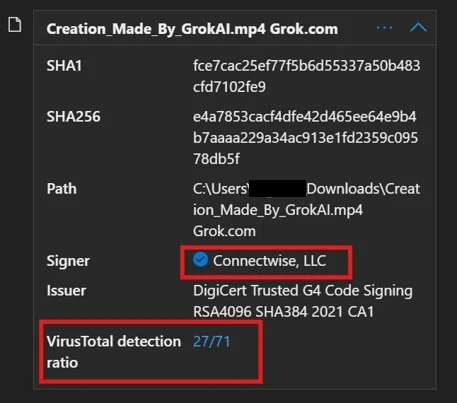
    A valid signature for a modified ScreenConnect installer.
    A valid signature for a modified ScreenConnect installer.

    Once executed, the installer dropped and launched the ScreenConnect client in the user’s Temp directory. Preconfigured to run hidden, it connected silently to an attacker-controlled ScreenConnect server via a relay, using parameters embedded within the authenticode signature to evade tampering and maintain a valid digital signature.

    Visual indicators such as icons and notifications were disabled, ensuring the session remained invisible to the end user.

    During the remote access session, the attackers deployed a batch script, “X-META Firebase_crypted.bat,” triggering mshta.exe to launch another hidden batch file. This script downloaded and unpacked “5btc.zip” from “anhemvn4[.]com,” revealing a Python interpreter renamed to pw.exe and an encoded “basse64.txt” payload.

    Instead of saving malicious code to disk, the threat actors used msedge.exe and chrome.exe process hollowing—injecting Base64–encoded Python commands fetched directly from a public GitHub repository. This fileless execution technique hindered static detection and allowed Xworm RAT components to be delivered stealthily.
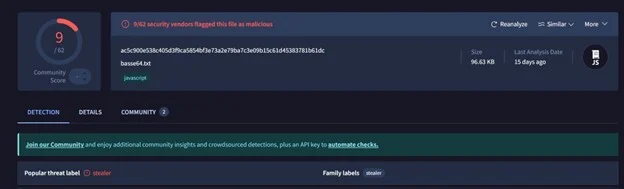
    basse64.txt being recognized as a known stealer on VirusTotal.
    basse64.txt being recognized as a known stealer on VirusTotal.

    Persistence was established by creating a Run key in HKEY_CURRENT_USER\Software\Microsoft\Windows\CurrentVersion\Run named “Windows Security,” pointing to a “backup.bat” script in “C:\xmetavip.”

    On each login, this script re-launched pw.exe with new Base64 commands, fetching additional payloads such as “buquabua.txt” to maintain long-term access.

    The campaign also included credential access and discovery stages. WMI queries gathered operating system and antivirus details, while the RAT attempted to harvest browser-stored login data from Chrome, Edge, and Firefox profiles.

    SpiderLabs analysts noted that the GitHub repository hosting the obfuscated Python scripts contained eleven files—split between persistence implanters and complex RAT loaders created just a week before the attack.

    One final payload script, “Exppiyt.txt,” embedded a command-and-control server IP (5[.]181[.]165[.]102:7705) that was not flagged as malicious on VirusTotal at the time of analysis.

    This incident highlights a growing trend: attackers are co-opting trusted tools and AI branding to bypass automated defenses. Modern EDR and signature-based solutions struggled to detect this threat, underscoring the vital role of proactive, human-led threat hunting.

    The SpiderLabs team’s investigation demonstrated that only through meticulous manual timeline analysis and behavioral hunting can these stealthy attacks be revealed.

    As adversaries refine their tradecraft, leveraging code-signing manipulation, fileless execution, and legitimate management platforms, organizations must invest in skilled threat hunters who can think like attackers.

    The SpiderLabs findings reinforce the strategic advantage of combining automated detection with expert analysis to uncover hidden threats before they can inflict damage.

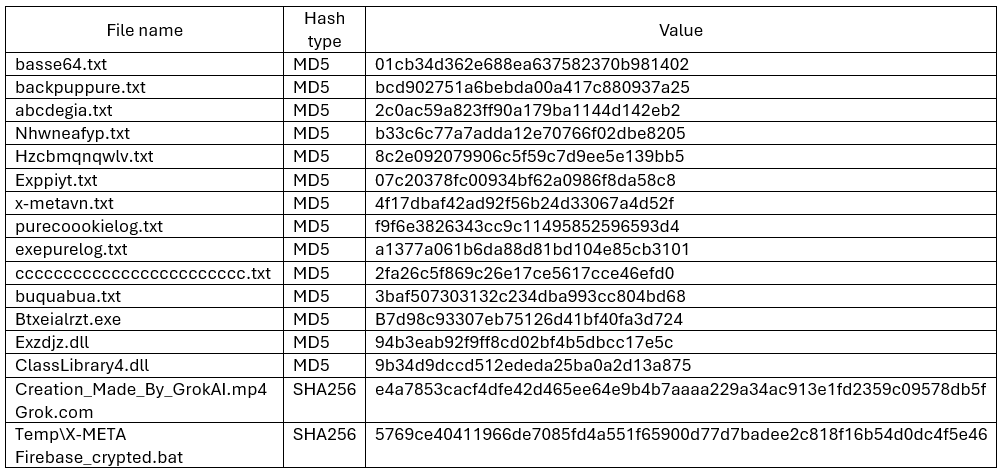
    Appendix – Indicators of compromise:
    Find this Story Interesting! Follow us on LinkedIn and X to Get More Instant Updates.

    The post Weaponized ScreenConnect RMM Tool Tricks Users into Downloading Xworm RAT appeared first on Cyber Security News.

    ¶¶¶¶¶

    ¶¶¶¶¶

    ¶¶¶¶¶

    ¶¶¶¶¶

    ¶¶¶¶¶

  • Too few defense contractors are testing their technology in real-world situations against a peer adversary, NATO’s military chief said Thursday, praising companies that are making the effort to work with the Ukrainian military.

    “Those few that have tried it have either learned a lot, or they’ve decided to go home because they can’t compete in that environment. But that is going to be the environment that we face,” said Gen. Alexus Grynkewich, who leads U.S. European Command and serves as NATO Supreme Allied Commander Europe.

    Grynkewich, who was speaking virtually to an industry group in Washington, D.C., urged any companies seeking to sell new products to NATO allies to attend September’s Defense Tech Valley conference in Ukraine.

    “They’re bringing in dozens and dozens of companies from across Europe who have co-production or co-licensing agreements and partnerships with the Ukrainians. It’s an incredible opportunity to see what the modern battlefield looks like today, what it might look like tomorrow, and what we might need in the future,” he said.

    Find partners with expertise

    NATO allies across Europe are raising defense budgets to meet a new, higher spending pledge. Much of what they buy will go to Ukraine, and much of what they spend will flow to the United States through a recent initiative dubbed the NATO Prioritised Ukraine Requirements List, or PURL. The month-old effort has already attracted more than $2 billion in pledges, with more expected. 

    Grynkewich described how European Command plays a central role in coordinating Ukraine’s requests for future capabilities with European and U.S. inventories. 

    “The Ukrainians will let us know what their requirements are. We then bring that into a combined U.S. European Command-and-NATO working group that elevates those requirements. And then I, as [Supreme Allied Commander], will elevate the requirement and send it back to them at the working group,” he said. “Some things are only going to come from the U.S. factory,” such as PAC-3 missiles.

    Grynkewich’s comments suggest that PURL’s pipeline can apply beyond missiles to anything Ukraine needs, including advanced drones. The framework is broad by design, allowing SACEUR and NATO to validate “other critical equipment” that the United States and allies may have or build, such as drones.

    At present, Ukraine’s biggest demand is for Patriot interceptors and other key air-defense systems to fend off barrages of missiles and drones. Grynkewich’s comments suggest that the testimony and feedback of Ukraine’s fighters will influence broad decision-making about the future building and stockpiling of weapons, not just for the United States but also for the future of European arms development, the world’s fastest-growing defense market.

    Grynkewich said new and established defense companies looking to benefit from future budgets would do well to “figure that out, find the right partners who have that expertise, and get up there and do some real-world testing. The lessons that you can learn from the battlefield of today and other regions of the world are going to be absolutely essential to any future fight in any region of the world, including the Indo-Pacific.”

    ]]>

    ¶¶¶¶¶

    ¶¶¶¶¶

    ¶¶¶¶¶

    ¶¶¶¶¶

    ¶¶¶¶¶

  • Five years after the Pentagon created an office to coordinate its counter-drone efforts, it’s trying again.

    The new Joint Interagency Task Force 401 will spearhead its acquisition and integration of air defense systems to take down small unmanned aerial systems, Defense Secretary Pete Hegseth announced Thursday in a video first posted to X.

    The group will “rapidly deliver Joint C-sUAS capabilities to America's warfighters, defeat adversary threats, and promote sovereignty over national airspace,” Hegseth wrote in a memo dated Wednesday.

    The memo also shuts down the existing Joint Counter-small Unmanned Aircraft Systems Office, which has been around since February 2020. It will also integrate the department’s Replicator 2 efforts. 

    “The JCO had great intentions but struggled to compel the different services and organizations to participate,” an Army official, who was not authorized to speak on the record, told Defense One. “Whereas the JIATF will have a lot more ability to coordinate and compel.”

    Hegseth’s “priorities for transformation and acquisition reform include improving C-sUAS mobility and affordability and integrating capabilities into warfighter formations,” he wrote in the memo.

    Hegseth’s memo lays out several guidelines for standing up the new task force:

    • It will have a director with acquisition authority, who will submit unfunded requirements for the 2026 fiscal year within the next 30 days.
    • It will immediately begin recruiting a technical lead and four personnel from the military services “with operations, acquisition, electronic warfare (EW), intelligence, or other C-sUAS competencies to include one officer in the grade of O-5 or higher who will have access to his or her Military Service' s decision-making officials.”
    • The under secretary of defense for research and engineering has 30 days to make recommendations on establishing a designated c-sUAS test and training range.
    • The Army has five days to submit requirements to the Pentagon building’s management for office space required to house the JIATF. 
    • The Army has 30 days to submit its full implementation plan to the defense secretary, and will update the secretary on progress monthly.

    In addition to this new DOD-wide effort to procure and employ counter-drone capabilities, the services have been working on their own acquisitions, which will continue, according to the memo.

    The Marine Corps this summer began fielding counter-drone systems to every infantry squad, while the Army is working on its own solutions.

    The JIATF, the Army official said, can coordinate some of those efforts across the services. 

    “If we’ve got a good solution to a problem that everybody has, let’s scale that solution, vice everybody trying to solve the problem independently,” the official said.

    ]]>

    ¶¶¶¶¶

    ¶¶¶¶¶

    ¶¶¶¶¶

    ¶¶¶¶¶

    ¶¶¶¶¶

  • The Trump administration is pausing training at the federal government's primary law enforcement academies for anyone not related to immigration enforcement, saying the change is necessary to meet the president’s “immediate priorities.” 

    The administration is in the midst of surging 10,000 employees to Immigration and Customs Enforcement after securing funding for the hires in the One Big Beautiful Bill Act, creating unprecedented demand at the Federal Law Enforcement Training Centers. Training needs could create bottlenecks as ICE seeks to rapidly onboard the new officers and agents, current and former officials have warned, and the administration is now taking drastic measures to avoid those pitfalls. 

    “To support the onboarding of 10,000 US Immigration and Customs Enforcement (ICE) Enforcement and Removal Operations personnel and 1,000 ICE Homeland Security Investigations personnel by Dec. 31st, 2025, we must focus our resources on surge-related training,” acting FLETC Director Paul Baker and his deputy, Ariana Roddini, said in a message to staff Wednesday. “As a result, training programs for agencies not directly involved in these efforts, originally scheduled between Sept. 9 and Dec. 31, 2025 will be rescheduled to later dates in Fiscal Year 2026.”

    More than 75 federal law enforcement agencies train at FLETC, which maintains its primary campus in Glynco, Georgia. Those agencies range from other Homeland Security Department components like Border Patrol and the Transportation Security Administration to the National Park Service, military police and inspectors general offices across government. 

    “We recognize the impact this decision may have on our partner agencies and the additional demands it places on our staff,” Baker and Roddini said. 

    The DHS component has stood up a Surge Training Operations Center to help manage the influx from ICE and “coordinate planning and execution.” That group is assembling daily to address challenges that arise and meet the administration’s priorities, while still supporting its partner agencies “as much as possible.”

    Baker and Roddini added they are examining whether other FLETC sites could accommodate critical training programs and are working with other agencies to find temporary solutions to meet their training needs. In addition to ICE’s 10,000 ERO hires, 1,000 HSI hires and normal federal law enforcement onboarding—which Trump has exempted from his governmentwide hiring freeze—the president’s signature immigration enforcement and tax bill funded 8,500 new employees for Customs and Border Protection and provided $3 billion for Bureau of Prisons hiring. 

    FLETC itself received $750 million to support those hiring efforts and current and former officials highlighted the need to quickly expand capacity at the training center to accommodate the surges. The current limitation on classrooms, instructors, firearms ranges and other assets could limit FLETC's throughout, they said. 

    Jason Owens, a longtime Border Patrol official who served as chief of the agency under President Biden and as its chief operating officer through March, recently told Government Executive that expanding capacity at FLETC could create its own speed bumps because construction “doesn’t happen overnight,” requires a buildup of procurement capacity and the typically-not-timely awarding of contracts.

    One FLETC employee said the agency did not “appear to be prioritizing the building of long term capabilities.” Instead, the employee said, “they look focused on short term, temporary fixes to accommodate the mission.”

    DHS did not immediately respond to a request for comment. For its part, FLETC stressed that it is committed to helping its own employees work through the changes. 

    “We understand the challenges this surge may present and are committed to providing the support and resources you need to carry out your responsibilities effectively,” Baker and Roddini said. 

    ICE has created a variety of incentives to identify new applicants, including recruitment bonuses of up to $50,000 and removing age caps for staff to serve. It has also slashed training time from six months to 48 days, The Atlantic reported this week. 

    ]]>

    ¶¶¶¶¶

    ¶¶¶¶¶

    ¶¶¶¶¶

    ¶¶¶¶¶

    ¶¶¶¶¶

  • South Korean authorities have successfully extradited a Chinese national suspected of orchestrating one of the most sophisticated hacking operations targeting high-profile individuals and financial institutions.

    The 34-year-old suspect, identified only as Mr. G, was repatriated from Bangkok, Thailand, on August 22, 2025, following a four-month international manhunt that resulted in his arrest for allegedly stealing over 38 billion won (approximately $28.5 million) from victims’ financial and virtual asset accounts.

    The criminal organization, operating from overseas offices primarily in Thailand, executed a complex multi-vector attack campaign spanning from August 2023 to January 2024.

    The group’s primary methodology involved infiltrating mobile carrier websites and other web platforms to harvest personal information from wealthy individuals, celebrities, corporate executives, and venture company representatives.

    Using this stolen data, the hackers gained unauthorized access to victims’ banking accounts and cryptocurrency wallets, systematically transferring assets without detection for months.

    Initial investigations revealed that the malware employed sophisticated social engineering techniques combined with technical exploitation of web application vulnerabilities.

    Moj.go.kr analysts identified the attack pattern as a coordinated effort utilizing both automated tools and manual intervention to maximize financial extraction while avoiding traditional security monitoring systems.

    Hacker got arrested (Source – Moj.go.kr)

    The operation’s technical sophistication became apparent through its multi-stage infection mechanism, which relied heavily on exploiting vulnerabilities in mobile carrier authentication systems.

    The malware initially gained entry through compromised web portals, where attackers injected malicious scripts designed to harvest user credentials and session tokens.

    Once inside the network perimeter, the malicious code established persistent backdoors using encrypted communication channels to maintain long-term access.

    The persistence tactics employed by this threat actor demonstrated advanced knowledge of system administration and network security protocols.

    The malware utilized a combination of registry modifications and scheduled task creation to ensure continuous operation across system reboots.

    Code analysis revealed the use of obfuscated PowerShell scripts that executed at regular intervals, checking for network connectivity and updating command-and-control server addresses dynamically.

    $encoded = [System.Convert]::FromBase64String($data)
    $decoded = [System.Text.Encoding]::UTF8.GetString($encoded)
    Invoke-Expression $decoded

    Detection evasion mechanisms included the implementation of anti-analysis techniques such as environment checking, sandbox detection, and runtime packing.

    The malware consistently modified its file signatures and employed living-off-the-land techniques, utilizing legitimate system tools like PowerShell and Windows Management Instrumentation to execute malicious activities while appearing as normal system processes.

    The successful extradition represents a significant victory for international cybercrime cooperation, with Korean authorities working closely with Thai officials, Interpol, and the Southeast Asia Cooperation Network to track and apprehend the suspect within just four months of his entry into Thailand.

    Boost your SOC and help your team protect your business with free top-notch threat intelligence: Request TI Lookup Premium Trial.

    The post South Korea Arrests Suspected Chinese Hacker Stolen Tens of Millions of Dollars from Victims appeared first on Cyber Security News.

    ¶¶¶¶¶

    ¶¶¶¶¶

    ¶¶¶¶¶

    ¶¶¶¶¶

    ¶¶¶¶¶

  • When web application protection is no longer a million-dollar luxury, and when every developer can build their own security perimeter with just a few clicks—that is when cybersecurity truly fulfills its mission. As a penetration tester, I’ve used zero-days to crush countless firewalls. But as a defender, I once found myself completely shut down by SafeLine […]

    The post How SafeLine WAF Turns Hackers’ Scanners into Trash appeared first on GBHackers Security | #1 Globally Trusted Cyber Security News Platform.

    ¶¶¶¶¶

    ¶¶¶¶¶

    ¶¶¶¶¶

    ¶¶¶¶¶

    ¶¶¶¶¶

  • Cybersecurity researchers have discovered a loophole in the Visual Studio Code Marketplace that allows threat actors to reuse names of previously removed extensions. Software supply chain security outfit ReversingLabs said it made the discovery after it identified a malicious extension named “ahbanC.shiba” that functioned similarly to two other extensions – ahban.shiba and ahban.cychelloworld –

    ¶¶¶¶¶

    ¶¶¶¶¶

    ¶¶¶¶¶

    ¶¶¶¶¶

    ¶¶¶¶¶

  • Cisco has released urgent security updates to remediate two medium-severity command injection vulnerabilities in its UCS Manager Software that could allow authenticated administrators to execute arbitrary commands and compromise system integrity. Disclosed on August 27, 2025, the advisory (cisco-sa-ucs-multi-cmdinj-E4Ukjyrz) affects multiple UCS fabric interconnect platforms and underscores the importance of timely patching to prevent potential […]

    The post Cisco UCS Manager Software Flaw Allows Attackers to Inject Malicious Commands appeared first on GBHackers Security | #1 Globally Trusted Cyber Security News Platform.

    ¶¶¶¶¶

    ¶¶¶¶¶

    ¶¶¶¶¶

    ¶¶¶¶¶

    ¶¶¶¶¶

  • Cisco has released urgent security updates to remediate a high-severity vulnerability in its Integrated Management Controller (IMC) virtual keyboard video monitor (vKVM) module that could allow unauthenticated, remote attackers to hijack sessions and redirect users to malicious websites. The flaw, tracked as CVE-2025-20317, carries a CVSS base score of 7.1 and affects a wide range […]

    The post Cisco IMC Virtual Keyboard Vulnerability Allows Attackers to Redirect Users to Malicious Websites appeared first on GBHackers Security | #1 Globally Trusted Cyber Security News Platform.

    ¶¶¶¶¶

    ¶¶¶¶¶

    ¶¶¶¶¶

    ¶¶¶¶¶

    ¶¶¶¶¶

  • Cybercriminals are increasingly weaponizing Microsoft Teams, exploiting the platform’s trusted role in corporate communications to deploy malware and seize control of victim systems.

    In a sophisticated campaign, threat actors are impersonating IT support staff in Microsoft Teams chats to trick employees into granting remote access, marking a dangerous evolution from traditional email-based phishing attacks.

    Social engineering remains a highly effective tactic for hackers, and as businesses have integrated platforms like Microsoft Teams into their core operations, attackers have followed. The inherent trust employees place in internal messaging makes it a fertile ground for deception.

    Recent campaigns analyzed by Permiso cybersecurity researchers reveal a multi-stage attack that begins with a simple message and culminates in the deployment of potent, multifunctional malware.

    PowerShell-based Malware via Microsoft Teams

    The attack chain often starts with a direct message or call from a newly created or compromised Microsoft Teams account. These accounts are designed to look legitimate, using display names like “IT SUPPORT ✅” or “Help Desk Specialist” to impersonate trusted personnel.

    Microsoft team Attack Chain
    Microsoft team Attack Chain

    Attackers often use checkmark emojis to simulate a verified status and leverage Microsoft’s onmicrosoft.com domain structure to appear as if they are part of the organization.

    Posing as IT staff addressing a routine issue like system maintenance, the attackers build rapport with their target.

    Once trust is established, they persuade the employee to install remote access software, such as QuickAssist or AnyDesk, under the guise of providing technical assistance. This critical step gives the attacker a direct foothold into the user’s machine and the corporate network.

    While similar techniques involving remote access tools have been linked to ransomware groups like BlackBasta since mid-2024, these newer campaigns are more direct, often forgoing the preliminary mass email campaigns seen in the past.

    The malicious payloads have also diversified, with recent incidents involving the DarkGate and Matanbuchus malware loaders.

    Once remote access is secured, the attacker executes a PowerShell command to download the primary malicious payload. This script is far from simple, equipped with capabilities for credential theft, establishing long-term persistence, and remote code execution, Permiso said.

    To evade detection and complicate removal, the malware can designate its own process as “critical,” which would cause the system to crash if terminated.

    It also uses a legitimate-looking Windows credential prompt to trick users into entering their passwords, which are then exfiltrated to an attacker-controlled server.

    Analysis of the payload’s code revealed hardcoded encryption keys that link the campaign to a known financially motivated threat actor tracked as Water Gamayun (also known as EncryptHub).

    This group has a history of combining sophisticated social engineering with custom malware to target English-speaking IT professionals and developers.

    Employees must be trained to remain vigilant against unsolicited contact, even on trusted internal platforms. All requests for credentials or the installation of remote access software should be independently verified through a known, separate communication channel.

    OHere is a table of the Indicators of Compromise (IoCs) based on the provided information.

    IndicatorType
    https://audiorealteak[.]com/payload/build.ps1URL
    https://cjhsbam[.]com/payload/runner.ps1URL
    104.21.40[.]219IPv4
    193.5.65[.]199IPv4
    Mozilla/5.0 (Windows NT; Windows NT 10.0; en-US) AppleWebKit/534.6 (KHTML, like Gecko) Chrome/7.0.500.0 Safari/534.6User Agent (UA)
    &9*zS7LY%ZN1thfIInitialization Vector
    123456789012345678901234r0hollahEncryption Key
    62088a7b-ae9f-2333-77a-6e9c921cb48eMutex
    Help Desk Specialist ✅User Display Name
    IT SUPPORT✅User Display Name
    Marco DaSilva IT Support ✅User Display Name
    IT SUPPORT ✅User Display Name
    Help DeskUser Display Name
    @cybersecurityadm.onmicrosoft[.]comUser Principal Name
    @updateteamis.onmicrosoft[.]comUser Principal Name
    @supportbotit.onmicrosoft[.]comUser Principal Name
    @replysupport.onmicrosoft[.]comUser Principal Name
    @administratoritdep.onmicrosoft[.]comUser Principal Name
    @luxadmln.onmicrosoft[.]comUser Principal Name
    @firewalloverview.onmicrosoft[.]comUser Principal Name

    As threat actors continue to innovate, a defense-in-depth strategy, combining technical controls with robust user education, is essential to protect against attacks that turn collaboration tools into conduits for compromise.

    Find this Story Interesting! Follow us on LinkedIn and X to Get More Instant Updates.

      The post Hackers Abuse Microsoft Teams to Gain Remote Access With PowerShell-based Malware appeared first on Cyber Security News.

      ¶¶¶¶¶

      ¶¶¶¶¶

      ¶¶¶¶¶

      ¶¶¶¶¶

      ¶¶¶¶¶