Threat actors recently infiltrated a corporate environment, dumped the AD database file NTDS.dit, and nearly achieved full domain control. AD acts as the backbone of Windows domains, storing account data, group policies, and password hashes. Compromise of its core file effectively hands attackers the keys to the kingdom. Attack Overview The breach began when attackers […]
In early 2025, LummaStealer was in widespread use by cybercriminals targeting victims throughout the world in multiple industry verticals, including telecom, healthcare, banking, and marketing. A sweeping law enforcement operation in May brought this all to an abrupt halt. After a quiet period, we are now seeing new variants of LummaStealer emerge. In light of […]
A critical zero-day vulnerability in Cisco Secure Firewall Adaptive Security Appliance (ASA) Software and Cisco Secure Firewall Threat Defense (FTD) Software is being actively exploited in the wild. Tracked as CVE-2025-20333, this remote code execution flaw allows an authenticated attacker to execute arbitrary code as root on affected devices. Cisco published an advisory on September […]
Cisco warns of a Critical remote code execution flaw in web services across multiple Cisco platforms. Tracked as CVE-2025-20363 (CWE-122), this vulnerability carries a CVSS 3.1 Base Score of 9.0 (AV:N/AC:H/PR:N/UI:N/S:C/C:H/I:H/A:H) and impacts ASA, FTD, IOS, IOS XE, and IOS XR Software.
Cisco Input Validation Flaw (CVE-2025-20363)
The flaw stems from improper validation of user-supplied input in HTTP requests. Attackers can craft malicious HTTP packets to bypass exploit mitigations and execute arbitrary shell commands as root.
For Cisco Secure Firewall ASA and FTD, no authentication is required; for IOS, IOS XE, and IOS XR, only low-privileged authenticated access is needed.
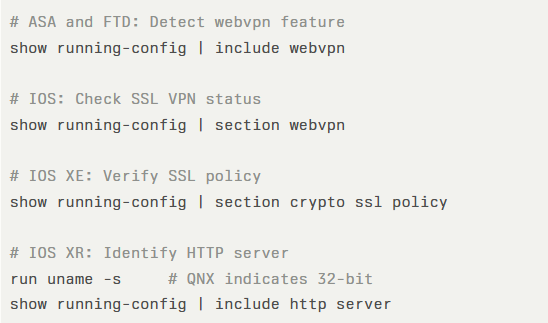
Affected services listen on SSL or HTTP ports when features such as webvpn, AnyConnect SSL VPN, or the HTTP server are enabled. Example CLI checks:
Successful exploitation yields a root shell, potentially leading to full device compromise.
Cisco acknowledges Keane O’Kelley of Cisco ASIG for discovering the defect. Coordination with ASD, CSE, NCSC, and CISA contributed to the advisory.
All ASA Series (5500-X, ASAv, Firepower 1000/2100/4100/9000, Secure Firewall 1200/3100/4200), FTD platforms, IOS routers with SSL VPN, IOS XE routers, and ASR 9001 running 32-bit IOS XR with HTTP enabled are vulnerable.
No workarounds exist. Customers must upgrade to fixed releases immediately. The advisory provides detailed fixed versions per platform under the Fixed Software section.
Risk Factors
Details
Affected Products
Cisco Secure Firewall ASA & FTD Software, Cisco IOS Software & IOS XE Software, Cisco IOS XR Software (32-bit on ASR 9001 with HTTP server enabled)
Impact
Remote unauthenticated code execution as root
Exploit Prerequisites
SSL VPN (webvpn) or AnyConnect SSL VPN enabled
CVSS 3.1 Score
9.0 (Critical)
Cisco recommends using the Cisco Software Checker to identify vulnerable releases and the earliest patches. Administrators should audit device configurations to confirm SSL VPN or HTTP server status.
For ASA/FTD, verify webvpn or AnyConnect SSL VPN settings; for IOS XR, ensure run uname -s returns Linux or disable HTTP via no http server. Cisco PSIRT confirms no active exploitation in the wild.
Security teams worldwide have been warned after attackers began exploiting a newly discovered zero-day vulnerability in Cisco Adaptive Security Appliance (ASA) 5500-X Series firewalls. The breach allows hackers to deploy sophisticated malware, dubbed RayInitiator and LINE VIPER, potentially giving them full control of affected devices. Today, the National Cyber Security Centre (NCSC), part of GCHQ, issued detailed guidance […]
A novel AI-driven threat leverages LLMs on Hugging Face to execute adaptive reconnaissance and data exfiltration in real time. Rather than relying on static scripts or prewritten payloads, LAMEHUG dynamically queries a Qwen 2.5-Coder-32B-Instruct model via the Hugging Face API to generate Windows command-shell instructions tailored to its current environment. This capability enables on-the-fly reconnaissance, […]
Cybersecurity authorities are urging organizations to take immediate action following the discovery of a sophisticated espionage campaign targeting Cisco Adaptive Security Appliance (ASA) firewalls.
In a significant update, Cisco and the UK’s National Cyber Security Centre (NCSC) have revealed that a state-sponsored threat actor is exploiting a zero-day vulnerability (CVE-2025-20333) in Cisco ASA 5500-X series devices to deploy advanced malware, execute commands, and exfiltrate sensitive data.
The NCSC has published a detailed analysis of the malware involved, a toolset comprising a bootkit named RayInitiator and a memory-resident payload called LINE VIPER.
The campaign represents a “significant evolution” in tactics compared to previous attacks, demonstrating the actor’s deep expertise and improved operational security.
A Sophisticated and Persistent Threat
The attack begins with the deployment of RayInitiator, a highly persistent, multi-stage bootkit that flashes itself to the device’s Grand Unified Bootloader (GRUB).
This allows the malware to survive system reboots and even firmware upgrades, establishing a permanent foothold on the compromised firewall.
RayInitiator specifically targets Cisco ASA models that lack secure boot technology, many of which are approaching their end-of-life dates. Its primary function is to create a pathway for the main payload.
Once persistence is achieved, the attackers deploy LINE VIPER, a versatile shellcode loader that executes directly in the device’s memory. LINE VIPER grants the threat actor extensive control over the compromised system, with capabilities including:
Command Execution: Running arbitrary commands with the highest privilege level (level 15).ncsc-mar-rayinitiator-line-viper.pdf
Data Exfiltration: Performing covert packet captures of sensitive network traffic, such as RADIUS, LDAP, and TACACS authentication protocols, to harvest credentials.
Defense Evasion: Suppressing specific syslog messages to hide malicious activity from administrators and employing anti-forensics techniques that can reboot the device if a memory dump or certain analysis commands are attempted.
Access Bypass: Maintaining a list of actor-controlled devices to bypass Authentication, Authorization, and Accounting (AAA) checks.
The malware’s command-and-control (C2) communications are heavily encrypted and difficult to detect. The primary method uses HTTPS WebVPN client authentication sessions, with victim-specific tokens and RSA keys securing the connection.
A secondary C2 channel utilizes ICMP requests tunneled within a VPN session, with exfiltrated data sent back over raw TCP packets.
Mitigations
Both Cisco and the NCSC are urging network defenders to address this threat immediately.
In a security advisory, Cisco has provided guidance for remediation and released patches to address the vulnerabilities. Organizations are strongly advised to apply these security updates without delay.
The NCSC calls on administrators using affected products to urgently investigate for signs of compromise, using the YARA rules and detection guidance provided in its malware analysis report.
One key indicator of a LINE VIPER infection is the device rebooting immediately when an administrator attempts to generate a core dump for forensic analysis.
A critical concern highlighted by the NCSC is the use of obsolete hardware. Many of the targeted Cisco ASA 5500-X series models will be out of support in September 2025 and August 2026.
The NCSC strongly recommends that organizations replace or upgrade these end-of-life devices, as they present a significant and inherent security risk. Any suspected compromises should be reported to the NCSC or the appropriate national cybersecurity agency.
Cisco published Security Advisory cisco-sa-http-code-exec-WmfP3h3O revealing a severe flaw in multiple Cisco platforms that handle HTTP-based management. Tracked as CVE-2025-20363, this vulnerability stems from improper validation of user-supplied input in HTTP requests. CVE Affected Products Impact CVSS 3.1 Score CVE-2025-20363 Secure Firewall ASA & FTD with SSL VPN or MUS enabled; IOS/IOS XE with Remote […]
Cybersecurity researchers have discovered an advanced variant of the XCSSET malware specifically targeting macOS developers through infected Xcode projects, introducing sophisticated clipboard hijacking and enhanced data exfiltration capabilities. Microsoft Threat Intelligence has identified yet another XCSSET variant in the wild that introduces further updates and new modules beyond those detailed in previous security analyses. The […]
Cisco has issued an emergency security advisory warning of active exploitation of a critical zero-day vulnerability in its Secure Firewall Adaptive Security Appliance (ASA) and Secure Firewall Threat Defense (FTD) software platforms.
The vulnerability, tracked as CVE-2025-20333, carries a maximum CVSS score of 9.9 and enables authenticated remote attackers to execute arbitrary code with root privileges on affected devices.
The vulnerability resides in the VPN web server component of both ASA and FTD software, specifically affecting devices with remote access VPN configurations enabled.
Cisco’s Product Security Incident Response Team (PSIRT) confirmed active exploitation attempts and emphasized the critical nature of this security flaw, which could result in complete device compromise.
Cisco ASA 0-Day RCE Vulnerability
The root cause of CVE-2025-20333 lies in improper validation of user-supplied input within HTTP(S) requests processed by the VPN web server.
This buffer overflow vulnerability (CWE-120) allows authenticated attackers with valid VPN credentials to craft malicious HTTP requests that trigger code execution with elevated privileges.
Vulnerable configurations include devices running ASA or FTD software with specific VPN features enabled, including AnyConnect IKEv2 Remote Access with client services (crypto ikev2 enable <interface_name> client-services port <port_number>), SSL VPN services (webvpn enable <interface_name>), and Mobile User Security (MUS) implementations.
The vulnerability specifically targets SSL listen sockets enabled by these configurations.
The exploitation process requires attackers to first obtain valid VPN user credentials, after which they can send specially crafted HTTP requests to the targeted device’s VPN web server.
Successful exploitation grants root-level access, potentially allowing threat actors to install persistent backdoors, exfiltrate sensitive network traffic, or pivot to internal network segments.
The discovery and investigation of this vulnerability involved unprecedented collaboration between multiple international cybersecurity agencies, including the Australian Signals Directorate, the Australian Cyber Security Centre, the Canadian Centre for Cyber Security, the UK National Cyber Security Centre (NCSC), and the U.S. Cybersecurity & Infrastructure Security Agency (CISA).
This coordinated response suggests sophisticated threat actor involvement, likely nation-state or advanced persistent threat (APT) groups targeting critical infrastructure.
CVE-2025-20362 is an unauthenticated unauthorized access vulnerability in the VPN web server of Cisco Secure Firewall Adaptive Security Appliance (ASA) and Secure Firewall Threat Defense (FTD) software.
Rated Medium severity with a CVSS 3.1 base score of 6.5, this flaw allows remote attackers to bypass authentication and access restricted URL endpoints.
The vulnerability stems from improper validation of user-supplied input in HTTP(S) requests handled by the VPN web server. Specifically, certain URL endpoints that should require authentication fail to enforce access checks.
An attacker crafts a malicious HTTP request targeting these endpoints and can retrieve or interact with sensitive resources without any valid VPN credentials.
Cisco Secure Firewall ASA/FTD VPN Web Server Unauthorized Access Vulnerability
6.5
Medium
Mitigations
Cisco emphasizes that no workarounds exist for vulnerabilities, making immediate software updates the only viable remediation strategy.
Organizations should prioritize patching all affected ASA and FTD devices using Cisco’s Software Checker tool to identify vulnerable releases and appropriate fixed versions.
The advisory specifically recommends reviewing threat detection configurations for VPN services using the command show running-config to identify vulnerable configurations. Network administrators should implement enhanced monitoring for unusual VPN authentication patterns and HTTP request anomalies targeting SSL VPN endpoints.
Given the active exploitation status and maximum severity rating, security teams should treat this vulnerability as a critical incident requiring emergency patching procedures.
Organizations unable to immediately patch should consider temporarily disabling vulnerable VPN configurations if operationally feasible, though Cisco notes this approach may impact business continuity for remote access requirements.