Malware operators aligned with North Korea have forged a sophisticated partnership with covert IT workers to target corporate organizations worldwide. This collaboration, detailed in a new white paper presented at Virus Bulletin 2025, sheds light on the intertwined operations of the DeceptiveDevelopment cybercrime syndicate and the WageMole activity cluster, revealing a hybrid threat that marries […]
Car makers don’t trust blueprints. They smash prototypes into walls. Again and again. In controlled conditions.
Because design specs don’t prove survival. Crash tests do. They separate theory from reality. Cybersecurity is no different. Dashboards overflow with “critical” exposure alerts. Compliance reports tick every box.
But none of that proves what matters most to a CISO:
The
CloudSEK has uncovered a sophisticated Loader-as-a-Service botnet campaign spanning the last six months, leveraging exposed command-and-control logs to orchestrate attacks against SOHO routers, embedded Linux devices, and enterprise applications. The threat actors exploit unsanitized POST parameters—such as NTP, syslog, and hostname fields—alongside default credentials and known CVEs in WebLogic, WordPress, and vBulletin systems to achieve […]
CISA has issued an Emergency Directive mandating immediate action to mitigate two critical zero-day vulnerabilities, CVE-2025-20333 and CVE-2025-20362, actively exploited against Cisco Adaptive Security Appliances (ASA) and select Firepower platforms.
The vulnerabilities allow unauthenticated remote code execution and privilege escalation, enabling advanced threat actors to modify read-only memory (ROM) for persistence through reboot and system upgrades.
Exploit Cisco ASA Hardware Zero-Days
CISA links this campaign to the ArcaneDoor activity first identified in early 2024, during which adversaries demonstrated the capability to manipulate ASA ROM as early as 2024.
By exploiting zero-days in ASA hardware, ASA-Service Module (ASA-SM), ASA Virtual (ASAv), and ASA firmware on Firepower 2100/4100/9300 devices, attackers achieve unauthenticated remote code execution.
Although Secure Boot on Firepower Threat Defense (FTD) appliances detects ROM manipulation, ASAs lack this protection, making them prime targets.
Cisco has released security updates addressing both vulnerabilities:
CVE-2025-20333 allows remote code execution on vulnerable ASAs.
CVE-2025-20362 permits privilege escalation to root-level access.
Failure to remediate poses an unacceptable risk to federal information systems and critical infrastructure.
CVE Identifier
Title
CVSS 3.1 Score
Severity
CVE-2025-20333
Cisco ASA Remote Code Execution Zero-Day
9.8
Critical
CVE-2025-20362
Cisco ASA Privilege Escalation Zero-Day
7.2
High
Emergency Directive
For all public-facing ASA hardware, perform CISA’s Core Dump and Hunt Instructions Parts 1–3 and submit core dumps via the Malware Next Gen portal by September 26, 2025, 11:59 PM EDT.
If “Compromise Detected,” disconnect (but do not power off), report to CISA, and coordinate incident response. If “No Compromise Detected,” proceed to software updates or device decommissioning.
Permanently disconnect ASA hardware with end-of-support on or before September 30, 2025. Agencies unable to comply must apply Cisco-provided software updates by September 26 and plan for decommissioning.
Download and apply the latest Cisco updates for ASA hardware models supported through August 31, 2026, and for all ASAv and FTD appliances by September 26, 2025.
By October 2, 2025, 11:59 PM EDT, submit a complete inventory and action report to CISA using the provided template. These measures apply to all federal information systems, including those hosted by third-party providers (FedRAMP-authorized or otherwise).
Agencies remain responsible for maintaining inventories and ensuring compliance. CISA will report cross-agency status and outstanding issues to senior leadership by February 1, 2026.
In late 2024, a new wave of cyber espionage emerged targeting global telecommunications infrastructure. Operating under the moniker Salt Typhoon, this Chinese state-sponsored group has focused its efforts on routers, firewalls, VPN gateways, and lawful intercept systems within major telecom providers.
By embedding bespoke firmware implants and leveraging living-off-the-land binaries, Salt Typhoon has achieved persistent access capable of siphoning sensitive communications metadata, VoIP configurations, and subscriber profiles.
The group’s objectives align with strategic Chinese intelligence priorities: signals intelligence (SIGINT) collection, counterintelligence support, and preparation of potential cyber disruption operations.
Salt Typhoon campaigns exploit both public-facing vulnerabilities in network edge devices and misconfigurations in management interfaces. Initial access is typically gained through exploitation of router web interfaces, such as CVE-2023-20198 on Cisco IOS XE and CVE-2023-35082 in Ivanti Connect Secure appliances.
After breaching these devices, the adversary deploys a custom firmware rootkit—internally dubbed Demodex—which survives reboots and evades standard detection mechanisms.
Domaintools analysts identified distinctive domain registration patterns supporting Salt Typhoon’s infrastructure, noting the use of fabricated U.S. personas and ProtonMail accounts for WHOIS entries, an unusual lapse in operational security for a state-sponsored actor.
Chinese Corporate Hacking Support Infrastructure (Source – Domaintools)
Once implanted, the malware establishes encrypted command-and-control channels over DNS beacons or HTTPS on TCP port 443.
Regular beacon intervals are disguised as routine firmware update checks, blending into normal network traffic. Exfiltrated data includes lawful intercept logs, call detail records (CDRs), and configuration dumps from edge routers.
Telecommunications providers in the United States, United Kingdom, and several European nations have reported unusual outbound traffic consistent with these implants, enabling the MSS (Ministry of State Security) to harvest high-value intelligence on user communications patterns and network topologies.
Operation impact
The impact of these operations extends beyond raw data theft. Long-dwell persistence in critical devices grants the attackers the ability to sabotage or reroute communications during geopolitical crises.
By maintaining backdoor access to core routers, Salt Typhoon can disrupt SIP traffic or inject false routing entries, potentially degrading service or enabling additional espionage within allied defense and government networks.
This blend of espionage and contingency planning underscores the dual-use nature of the campaign: everyday intelligence collection complemented by latent offensive capabilities.
A deeper look at Infection Mechanism reveals the precision of Salt Typhoon’s exploitation and implant deployment.
The group’s engineers have crafted a minimalistic loader that leverages the router’s own command shell to write malicious binaries into /usr/bin/ and modify startup scripts.
For instance, a typical persistence snippet injected into a Juniper device’s configuration might appear as:-
This code writes the loader invocation into the router’s boot sequence and flashes the rootkit into flash memory. The loader verifies the firmware version and selects the appropriate memory offsets to avoid bricking the device.
Once executed, Demodex hooks low-level system calls to intercept configuration reads and hide its presence, ensuring subsequent firmware updates cannot remove it without manual intervention.
By combining targeted exploitation of known CVEs, stealthy firmware implants, and contractor-enabled domain infrastructure, Salt Typhoon represents a sophisticated example of China’s evolving cyber espionage capabilities against telecommunications networks.
The campaign’s operational model—outsourced infrastructure provisioning paired with state-directed tasking—poses significant challenges for attribution and defense, but also offers defenders opportunities to disrupt emerging domains and certificate pivots before active exploitation begins.
Follow us on Google News, LinkedIn, and X to Get More Instant Updates, Set CSN as a Preferred Source in Google.
Active Directory (AD) remains the foundation of authentication and authorization in Windows environments. Threat actors targeting the NTDS.dit database can harvest every domain credential, unlock lateral movement, and achieve full domain compromise.
Attackers leveraged native Windows utilities to dump and exfiltrate NTDS.dit, bypassing standard defenses.
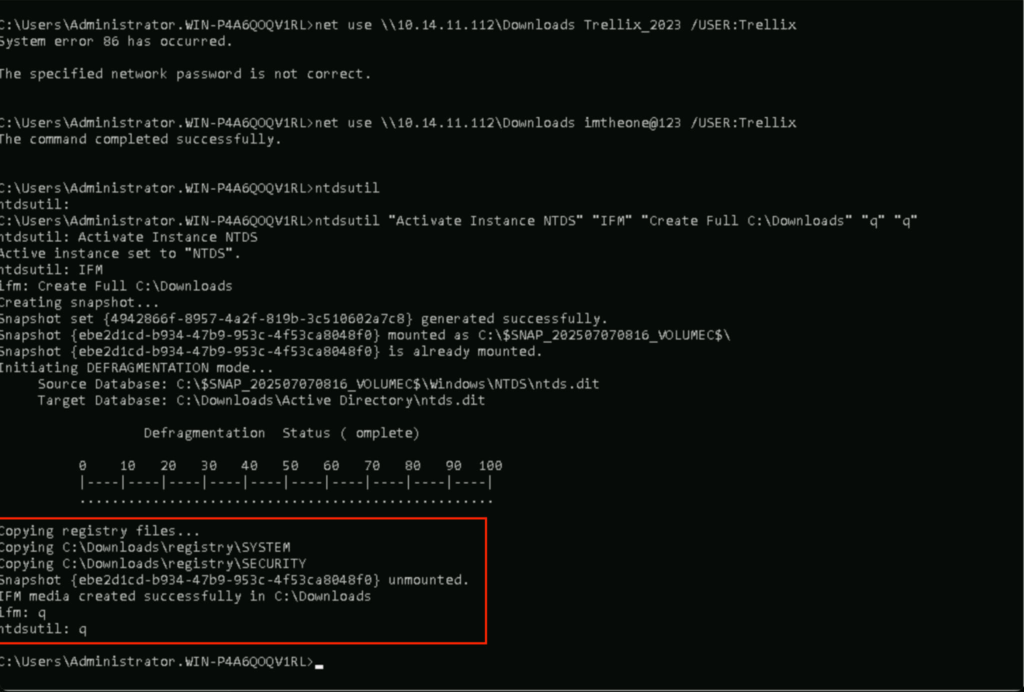
The adversary in this case obtained DOMAIN ADMIN privileges via a successful phishing campaign and subsequent privilege escalation. Once elevated, they executed:
To create a Volume Shadow Copy and extract NTDS.dit, silently bypassing file locks. With the SYSTEM hive obtained, attackers decrypted the database offline using secretsdump.py from Impacket:
This chain enabled harvesting of NTLM and AES hashes for all domain accounts without triggering traditional endpoint alarms.
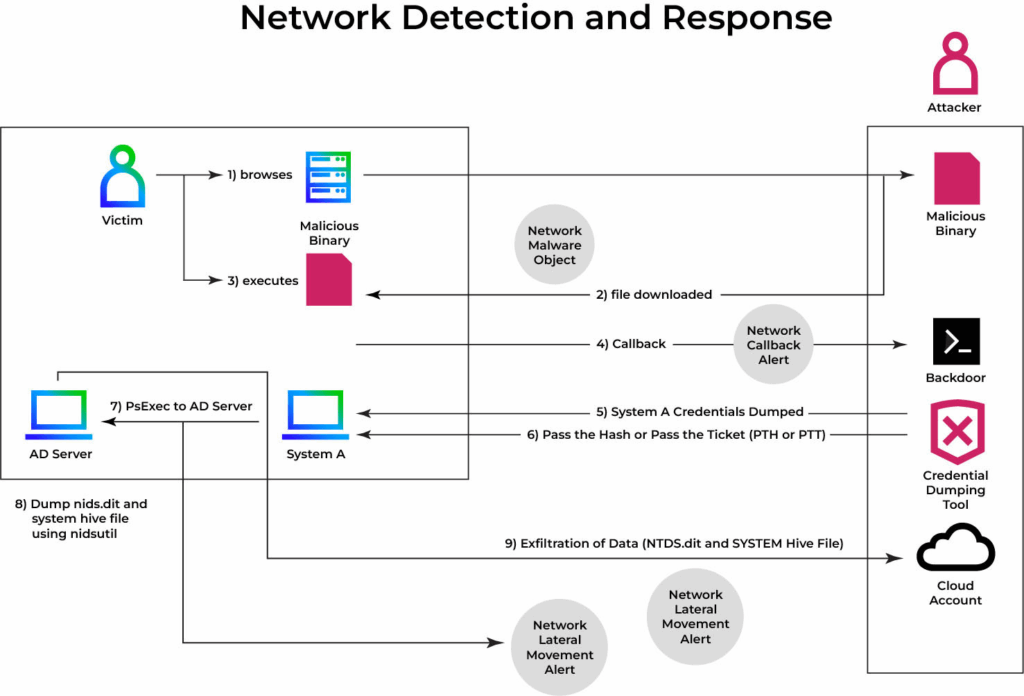
Full Kill Chain
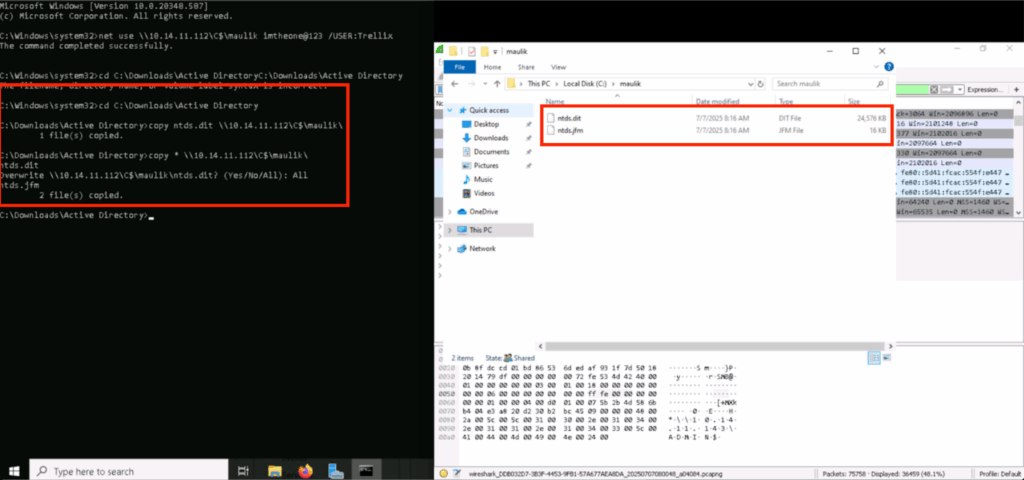
After archiving and compressing the dump with tar -czf ntds.tar.gz c:\temp\ntds.dit c:\temp\SYSTEM, the attackers exfiltrated data over SMB to a compromised file share.
NTDS.dit file dump
Trellix detected this activity via two high-fidelity signatures: anomalous SMB write patterns exceeding baseline volume and a custom exfiltration signature for large NTDS file transfers.
Behavioral detection flagged unexpected esentutl processes running outside maintenance windows, and protocol anomaly alerts triggered on shadow copy reads to C:\$VolumeShadowCopy.
Through Trellix Wise, AI-driven alert correlation highlighted the progression from VSS creation to SMB upload, reducing analyst workload by 60% and cutting mean time to detect (MTTD) by 45%.
The theft of NTDS.dit poses an existential threat to Windows domains, providing attackers complete control over all credentials.
NTDS.dit archived for exfiltration
Traditional defenses often miss the low-and-slow techniques employed during shadow copy creation and offline decryption.
A loosely connected cybercrime supergroup is exploiting social engineering to compromise Fortune 100 organizations and government agencies. LAPSUS$, Scattered Spider, and ShinyHunters—three of the most notorious English-speaking cybercrime groups—have increasingly blurred their lines through shared tactics, overlapping membership, and joint public channels. From 2023 through 2025, evidence has emerged of direct collaboration on high-profile breaches […]
Cybersecurity company watchTowr Labs has disclosed that it has “credible evidence” of active exploitation of the recently disclosed security flaw in Fortra GoAnywhere Managed File Transfer (MFT) software as early as September 10, 2025, a whole week before it was publicly disclosed.
“This is not ‘just’ a CVSS 10.0 flaw in a solution long favored by APT groups and ransomware operators – it is a
Cybercriminals have launched a sophisticated supply chain attack targeting cryptocurrency developers through malicious Rust crates designed to steal digital wallet keys.
Two fraudulent packages, faster_log and async_println, have infiltrated the Rust package registry by impersonating the legitimate fast_log logging library, embedding malicious code that scans source files for Solana and Ethereum private keys before exfiltrating them to attacker-controlled servers.
The malicious crates were published on May 25, 2025, under the aliases rustguruman and dumbnbased, accumulating 8,424 combined downloads before their discovery.
These packages maintained functional logging capabilities to evade detection while secretly harvesting cryptocurrency credentials from developers’ source code and project files.
The attackers employed typosquatting techniques, copying the original fast_log’s README documentation and repository metadata to create convincing imposters that could pass casual review processes.
Socket.dev analysts identified the malicious packages during routine threat monitoring, discovering their sophisticated credential theft mechanisms.
The researchers found that both crates implemented identical exfiltration workflows, scanning for three specific patterns: Ethereum private keys formatted as 64-character hexadecimal strings with 0x prefixes, Base58-encoded Solana addresses and keys ranging from 32 to 44 characters, and bracketed byte arrays that could contain encoded key material.
Center shows the legitimate fast_log, while left (faster_log) and right (async_println) are malicious (Source – Socket.dev)
Upon detection of any matching patterns, the malware immediately transmits the stolen credentials to a hardcoded command and control endpoint hosted at mainnet.solana-rpc-pool.workers.dev, cleverly disguised to resemble legitimate Solana RPC infrastructure.
The attack vector exploits developer trust in package repositories, demonstrating how minimal code modifications can create significant security risks.
The threat actors maintained the original logging functionality while embedding their credential harvesting routines, ensuring the packages would function as expected during initial testing and integration phases.
This approach allowed the malicious code to operate undetected within development environments and continuous integration pipelines.
Technical Implementation and Exfiltration Mechanism
The malware’s core functionality revolves around a sophisticated scanning engine implemented in Rust that recursively processes project directories.
The malicious code utilizes regular expressions to identify cryptocurrency-related secrets embedded in source files, focusing specifically on patterns commonly used by blockchain developers.
The implementation employs three targeted regular expressions for pattern matching. The first targets Ethereum private keys using the pattern "0x[0-9a-fA-F]{64}" to capture 64-character hexadecimal strings prefixed with 0x, which represent standard Ethereum private key formats.
The second regex "[1-9A-HJ-NP-Za-km-z]{32,44}" identifies Base58-encoded strings typical of Solana addresses and public keys, with length constraints matching Solana’s cryptographic specifications.
The third pattern captures bracketed byte arrays in formats like [0x12, 0xAB, ...] or [1,2,...] that could contain raw key bytes or embedded seed phrases.
Crates.io search for fast_log showed the legitimate fast_log alongside two imposters, faster_log and async_println (Source – Socket.dev)
When the scanning function identifies matching patterns, it constructs detailed forensic records that include the exact file path, line number, matched value, and pattern type.
This precise location tracking suggests the attackers may have intended to conduct follow-up operations or provide detailed intelligence to buyers of the stolen credentials.
The malware batches multiple discoveries into JSON payloads before transmitting them via HTTP POST requests to the attacker’s command and control infrastructure, utilizing standard HTTPS encryption to blend with legitimate network traffic.
The exfiltration mechanism operates through a Rust reqwest client that sends structured data to the Cloudflare Workers-hosted endpoint.
This hosting choice provides the attackers with anonymity, scalability, and the ability to rapidly modify their collection infrastructure without maintaining dedicated servers.
The malicious crates process files at application runtime rather than during compilation, ensuring the scanning occurs within developers’ active working environments where cryptocurrency credentials are most likely to be present and accessible.
Follow us on Google News, LinkedIn, and X to Get More Instant Updates, Set CSN as a Preferred Source in Google.
Cybersecurity researchers have discovered an updated version of a known Apple macOS malware called XCSSET that has been observed in limited attacks.
“This new variant of XCSSET brings key changes related to browser targeting, clipboard hijacking, and persistence mechanisms,” the Microsoft Threat Intelligence team said in a Thursday report.
“It employs sophisticated encryption and obfuscation